End of an era – and the start of a new one?

China is changing, not only with the CPC leadership change through the 18th party congress a few weeks ago. Thursday morning last week, 22 November, bishop Ding Guangxun (K. H. Ting 丁光训) passed away, just over 97 years old. Today, 27 November, his funeral was held in Nanjing. You never heard of him? Well, he was not that often mentioned in Western media, and his death seems to have escaped Western attention almost totally, except for brief statements by the World Council of Churches (世界基督教会联合会), the Fuller Theological Seminary (福乐神学院) and a few others.

This is quite remarkable. Bishop Ding was one the major Protestant leaders in China for nearly 60 years, and from the late 1970s he was predominant leader of the Three-Self Movement (三自爱国运动) until his death. He established the China Christian Council (中国基督教协会) in 1980, which became a more church-like structure in post-denominational China. All Protestant denominations were abolished in 1958.
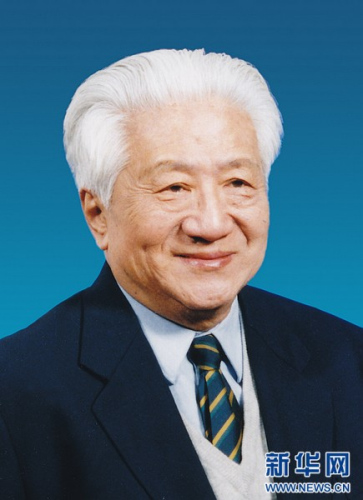
Bishop Ding Guangxun

When he died the registered congregations within China Christian Council had around 25 million members, probably the largest Protestant church in the World. It is noteworthy, however, that so-called ”house churches” (家庭教会), or better ”unregistered churches” (非登记教会), probably have even more members together, making the total number of Protestants in China more than 50 million.

Bishop Ding initiated one of China’s first NGOs, the Amity Foundation in 1985. But he was also very controversial, because of his close relation to the party-state. He was one of the Vice Chairmen of the the Chinese People’s Political Consultative Conference (中国人民政治协商会议 CPPCC) for almost twenty years (until 2008). He was also on the standing committee of the National People’s Congress (中国人民代表大会 NPC), China’s parliament. The CPC called him a ”close friend of the Communist party” (中国共产党的亲密朋友) after his death.

He was often criticized for being a ”non-believer” (不信派), and for what some saw as theological deviations. Such comments have dominated Chinese microblog Weibo writings about him the last few days. Others loved him, and credited him for making it possible for the church to function openly in China at all. He was respected by many as an important ecumenical leader in the worldwide church.

His last years were darkened by dementia (失智症) and hospitalization, but as long as he lived his thinking and theology continued to influence church life in China. Research on his life and theology is only starting, but Philip L. Wickeri (魏克利) and Li Jieren (李洁人) have already made good contributions. But what will happen now? Will the church be even more fragmented, will denominations come back? How will the party-state react? At best Ding’s legacy will serve as a reminder and inspiration for the future, and a new era will start. At worst things will just continue, without reflection and change.
What happens in Xinjiang? Or, China is not only Beijing and the CPC congress

These days of 18th CPC congress (十八大) frenzy, it can be interesting to note that many other things happen around China. A few weeks ago news emerged about an attack on a border post in Kargilik county (叶城县), south of Kashgar in Xinjiang. The attack occurred on Chinese national day 1 October. A young man rode his electric bike (电单车) into a border post, and around 20 people were killed or injured in an explosion. The border post was in Kokkowruk village (阔可寇热克村) in Chasamechit township (恰萨美其特乡).

Not long before the attack, but well ahead of the party congress, state news agency Xinhua (新华社) started a dedicated Uyghur news page. It almost immediately came under fire from Uyghur exiles for ”brainwashing” Uyghurs. But how many people trust official Chinese media without reflection, even in Xinjiang? Maybe no-one cares, but maybe it also fits very well with CPC media strategy and with giving an image of multiculturalism.

The media focus on the CPC congress is understandable, but one may also learn much about what happens in China through watching other areas, following trends and events outside Beijing. It is highly unlikely that anything unexpected would happen at the CPC congress, and that Xi Jinping and other leaders-elect would make drastic changes day one of their term of office. Therefore it is more interesting to look into the play on the sides, the protests in the countryside – and the games around leaders even further on in time. It seems that even Xinjiang may play a part in the game.

”Iron fist against terror” – Nur Bekri

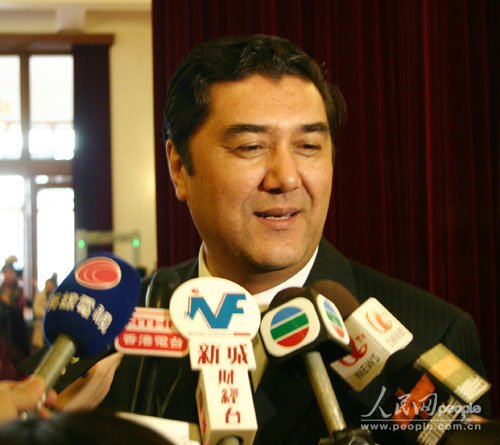
In 2009 the Chinese journal Huanqiu renwu 环球人物 (Global People, a subsidiary of People’s Daily) published an interesting article on the questions of youth and “the 6th generation” leaders. Xinjiang governor Nur Bekri (Nu’er Baikeli 努尔·白克力) was ranked among the top five of ”the post-60” (60后) CPC leaders, the generation born after 1960. He is portrayed as a ”scholar ruling the region” (文人治区) and an ”iron fist against terror” (铁腕反恐). What do we make of this? Nur Bekri and the four others (Zhou Qiang 周强, Sun Zhengcai 孙政才, Hu Chunhua 胡春华 and Lu Hao 陆昊) were predicted to become top party leaders in 2022, at the 20th CPC congress. The idea that an Uyghur would even be considered is quite astonishing, even if it is only a token ”affirmative action Chinese style”. It has never happened before. But will there be a 20th CPC congress?

No words by Mo Yan?

Finally! That must have been the word on many Chinese lips this evening as the Swedish Academy (瑞典学院) announced that Mo Yan (莫言, real name Guan Moye 管谟业) would be given the Nobel prize in literature 2012. Almost instantaneously some Chinese voices got overexcited, and professor Zhang Yiwu (张颐武) from Peking University claimed that ”Mo Yan getting the prize is really an outcome of China’s rise and development, and Chinese civilization can no more be neglected” (莫言的得奖其实是中国的崛起和发展带来的结果,中国文明已经不能被忽视). Zhang is a professor at the Chinese Department and Vice Director of Peking University Centre for Research on Cultural Resources (北京大学文化资源研究中心). Is Mo Yan now a ”cultural resource”?

Apparently people still read – and like – his books. This evening I was giving a lecture on ”Sinology, literature and translation”. As the prize announcement coincided with the start of my lecture I put on the webcast from Stockholm, and to all our surprise ”Mo Yan” were the words pronounced. The students, all except two Mainland Chinese in their 20s, were laughing and clapping hands, and they had all read Red Sorghum (红高粱) – or at least seen the film, some has also read Big Breasts and Wide Hips (丰乳肥臀) and Frog (蛙).

Despite the Nobel Prize, this year has not only been positive for Mo Yan. Earlier this year he was severely criticized for taking part in copying by hand a part of Mao Zedong’s Talks at the Yan’an Forum for Literature and Art (在延安文艺座谈会上的讲话). 99 other writers and artists did the same. One wonders why. One can also wonder if his choice of pen name may have gone too far – Mo Yan means ”no words” or ”no speech”. He has claimed that it was taken to remind himself not to speak too much, as he was earlier known for his outspokenness. Being a Nobel laureate will give him time and space to reconsider and maybe start speaking again. He could start by mentioning the other Chinese citizen who has won the Nobel prize, Liu Xiaobo.

How do you get fifteen years in a Chinese prison?

Former Chongqing vice mayor and police chief Wang Lijun (王立军) was sentenced to fifteen years in prison yesterday for ”bending the law for selfish ends, defection, abuse of power and bribe-taking” (徇私枉法、叛逃、滥用职权、受贿). A detailed account of the trial was also published by the official news agency Xinhua. Without mentioning him by name, only by position, it was revealed during the trial that Bo Xilai had literally ear slapped Wang Lijun when he told Bo of his wife Gu Kailai’s alleged involvement in the killing of British businessman Neil Heywood. How will Bo Xilai be punsihed for that – or will he? Hopefully People’s Daily offspring Global Times is right when saying ”… justice will eventually trump over any privilege”.

Actually, Wang Lijun got several sentences of seven, nine and two years, that would combine to 20 years in prison, but he was instead given a total of fifteen years, and one year deprivation of political rights. It is likely that his revealing of facts around the Bo-Gu affair helped reduce his sentence.

Besides the bizarre setting of the whole case, it gives some perspective to Chinese criminal punishment. In 2009 Uyghur Christian Alimjan Yimit (阿里木江·依米提) was also sentenced to fifteen years in prison for ”illegally revealing state secrets to a foreigner” (向境外人员非法提供国家秘密). He had told his American friend of the pressure he received from the local religious affairs office. Is that a state secret? In 2010 Uyghur journalist Gheyret Niyaz (海莱提·尼亚孜) was also sentenced to fifteen years in prison for ”endangering state security” by talking to Asia Weekly (亞洲週刊).

Abuse of power is a central issue in all these three cases. Global Times writes also on this: ”Is such abuse of power by Wang [Lijun] an individual case, or is it typical?”. It seems typical to me.

A good read – China in Ten Words

I buy too many books, and often there is no time to read them directly. I bought Yu Hua’s China in Ten Words (十個詞彙裡的中國) while visiting Hong Kong in April this year, but only started reading recently, bringing the book back to Hong Kong… Yu Hua (余华) is one of China’s best known writers, and has had great success with novels as Brothers (兄弟) and To live (活着), of which the later was filmed by Zhang Yimou (张艺谋) and became a great success around the World.

One of Yu Hua’s ten words is ”reading” (阅读). Nowadays, when an ebook is only a click away on your ”pad”, it is a necessary reminder to read his story of how people lined up outside the bookstores days ahead of a new release when censorship eased after Mao’s death in the late 1970s. Being here in Hong Kong is probably a good environment to read this particular book, in China but still not, just as the book is written in China but not published in the PRC.

Many of the stories relate to Yu Hua’s youth during the Cultural Revolution, but are also highly relevant to contemporary China. The ten words point to many of the current problems in China, such as ”disparities” (差距) and ”leader” (领导). The cult of Mao as ”the great helmsman” seems absurd and frightening today, but recent events around the ”disappearance” and ”reappearance” of supposed new leader Xi Jinping (习近平), and the mystery surrounding it, tells us that the word ”leader” is still of great importance.

One story tells how Yu Hua escapes the summer heat in his southern hometown by napping in the mortuary of the hospital where he lives, both his parents being doctors. On ”the clean, cool cement bed” he could find some peace. When Yu Hua visited Sweden a few years ago, I interpreted for him as he spoke on ”the imagination of a writer”. Not an easy task, and when he then told this same story the word ”mortuary” (太平间) was one (of several…) that escaped my mind. A senior colleague in the audience gave me the word, and the lecture went on as normal. Now that I read Yu Hua’s book and recognize this story, I realize that I will never forget the word ”mortuary” in Chinese.

Sensitive politics? Culture, weibo and 9 September

Today is a special day, 9 September. Here in Hong Kong elections are under way, and the  government yesterday backed down from the idea of introducing compulsory ”moral and national education” (德育及國民教育科). Massive demonstrations and today’s elections were probably the main factors behind this decision. Perhaps also concerns from Beijing about possible unrest in Hong Kong so close in time to the upcoming Communist party congress in October? It will be interesting to see election results.

Today is also the anniversary of Mao Zedong’s death. People’s Daily (人民日报) does not promote it at all, but interestingly a People’s Daily affiliated blog yesterday had a post about ”Mao Zedong’s six most beautiful dance partners” (毛泽东一生中最漂亮的六个舞伴) ! Ironic and strange, and not quite a ”harmonious” topic on the anniversary of Mao’s death.

It is also a little strange that Weibo, the Chinese micro blog, seems to be very picky with words today. Probably not because of Mao Zedong, but more likely because of Hong Kong and the elections. This morning I wrote a short Weibo on the somewhat tragic but fascinating story of artist Sun Guojuan (Son Kok Gyon 孙国娟), and how she was denied visa to exhibit in Sweden, most likely because she has North Korean citizenship.

Dangerous words?

When I published, it came out as of above, ”limited to private viewing” (仅自己可见)! I have had Weibo post censored before, but then they were published first and then erased. I immediately republished, but this time without the words ”citizenship” (国籍) and ”political” (政治) and it came out normal (as you can see in the Weibo feed on the right). Do they censor the words ”political” or ”politics”? The ways of Weibo and Chinese Internet censorship are truly mysterious.

Elections, brainwashing and hunger strike – Hong Kong thoughts

Arriving in Hong Kong to work a year at City University of Hong Kong (香港城市大學), it is definitely time to start blogging again. The first week has been full of practical things, but also many thoughts on Hong Kong society as I and my family face the various bureaucratic and other obstacles to overcome before a more ordinary life can start.

One major event these days is the election to the Legislative Council  (香港立法會) taking place on 9 September.

Hong Kong voters can cast two votes, for geographical and functional constituencies. Will that give them more influence?

Interestingly, my new colleagues and other local friends have yet to mention the elections in our conversations. Newspapers and other media, however, are full of interesting stories. Just a few days ago several people were sentenced for election fraud, in regard to district elections in 2011. Reports specially pointed out one woman as having a PRC background, and speculated that she was ”brainwashed” as a child in mainland China. She described herself as a ”Post-80 refusing to be brainwashed” (拒絕被洗腦的80後), but acknowledging her father’s ”patriotism and love of the party” (愛國愛黨).

”Be on guard against pickpockets” 提防扒手 (grabbing ”freedom” 自由) and ”beware of brainwashing” 小心洗腦 – poster for the Civic Party (公民黨)

”Brainwashing” has become an issue after the government proposal for revision of the compulsory ”moral, civic and national education” course (德育及國民教育科) for primary and middle schools. One proposed teaching material is called The China Model: Handbook for Teaching National Conditions [Sentiments] (《中國模式》國情專題教學手冊), which, among other things, describes the Communist Party of China (CPC) in very positive terms.

This led to huge demonstrations in July, and recently – ahead of term start – protests outside the government buildings. A couple of middle school students even started a hunger strike (絕食). The Hong Kong Professional Teachers’ Union (香港教育專業人員協會) has also been especially outspoken on this issue, which has led to very harsh, but revealing comments from Beijing, voiced through Ta Kung Pao (大公報) and relayed by China Daily. It will be interesting to follow developments on-the-spot!

”Elders” who speak out

In the wake of the Wang Lijun-Bo Xilai-Gu Kailai-(and whoever more is involved…) scandal, the so-called ”security chief” (安全头目) Zhou Yongkang (周永康) have been hit by rumours. The latest is that he already has been stripped of real power, and 9 May a group of ”party elders” (党内元老) published an open letter asking for his public dismissal. Now and then such groups of ”elders” speak out on certain issues, sometimes with positive response and real effect, sometimes only met with silence. Usually, there are a few more well-known names among the signatories, and ”elders” do not only point to age but political seniority.

In this case the undersigned all come from Zhaotong (昭通) in Yunnan, a very poor area, and none has had any senior position. Leading writer is Yu Yongqing (余永庆), b. 1933, and short life-stories of him and other signatories can be found online. Most of them were badly hit by the ”anti-rightist” campaign in 1957, and they have also been publishing other letters and stories in regard to the 55th anniversary of this campaign. But will their letter have any impact on Zhou Yongkang or CPC decisions? Not likely. It more seems like media spinning on rumours ahead of the upcoming 18th CPC congress this autumn.

There are, however, other ”elders” who speak and who should get more attention. Cheng Siwei (成思危), b. 1935 is not a Communist party member, but a former China Democratic National Construction Association (中国民主建国会) leader, and also former Vice Chairman of the Standing Committee of the National People’s Congress. At the 60th anniversary celebrations for China University of Political Science and Law (中国政法大学) 16 May, Cheng Siwei spoke on rule of law and division of power, among other things. He said he following (around 2:00 on the video clip):

We must first establish the concept of a legal system. You could say that in the minds of some officials the issue of which is greater, the party or the law, has not yet been fully resolved.

我们首先应该树立一种法制的观念。可以说现在有一些个别的官员头脑中党大还是法大的问题并没有真正的解决。

As the leading role of the Party is written into the constitution of the PRC, it cannot be easy for ”some officials” to come to a final conclusion on this issue… but it is certainly time to establish rule of law in China.

Hidden agendas – or confused Confucians?

During my recent visit to Beijing I went for a walk one morning, and ended up at Guozijian (国子监) and the Confucius Temple (孔庙). Guozijian was a kind of national academy for examinations (科举) during imperial times. A few Chinese tour groups passed through, and there was a distinct smell of incense, but I could not see it burning anywhere. I heard a tour guide discuss the difference between burning incense in a Buddhist temple and a Confucius temple, focusing on the different things one should ask for at each place… Popular ”Confucian” worship in the middle of Beijing?

Yu Dan (于丹) speaks at the Confucius ceremony in Beijing in 2010. Her popular book "Confucius from the Heart" (论语心得) has sold many million copies around the World.

In the side buildings were exhibitions about Confucian ceremonies and on Confucianism and its influence in the World. The exhibition on Confucian influence made me confused. The final display showed the distribution of Confucius Institutes (孔子学院), and the text in both English and Chinese explained:

[we] shall carry traditional Chinese culture and Confucianism forward to the world, establishing Confucianism as an outstanding branch among the various world cultures
把以孔子儒学为主干的中国传统文化传向世界,使孔子儒家学说成为世界多元文化中的一枝奇葩

So much for the criticism of Confucius Institutes as tools of Communism! This is their true aim… or maybe not? Other texts claimed, in both Chinese and English, that Gottfried Leibnitz (莱布尼兹) was a German missionary. I thought he was a philosopher inspired by Confucianism.

Painting of Kim Jong Il funeral, December 2011, displayed at Guozijian exhibition

It all seems very confused and haphazard for being the second most ”sacred” place for Confucianism in China after his birthplace Qufu (曲阜). However, I found more clues to contemporary ”Confucianism” as I was about to leave Guozijian. In the last side building there was a temporary art exhibition. To my great surprise it was an exhibition to commemorate the 100th anniversary of the birth of Kim Il Sung (金日成), ”eternal president” of North Korea! I would rather not see Kim as a benevolent Confucian father figure, but maybe someone thought it would be a proper place for him. A more plausible interpretation would be that not many people visit Guozijian, and it is therefore easy to ”hide” such an exhibition, unwanted but necessary for diplomatic reasons. ”Confucianism” can be very useful…

Time for a new song — “The East is shaking” (to the tune of “The East is Red”)

The time when ”singing red songs” (唱红歌) was considered to ”fill us with enthusiasm and unbounded confidence” (激情满怀、信心百倍) is over for this time. Many people thought that time passed already in the 1970s. As much as Bo Xilai dismissed as ”complete nonsense” (无稽之谈) the claims that ”red songs” were ”leftist” and a way back to ”the Cultural Revolution”, he was himself dismissed from the politburo (政治局). His wife Gu Kailai (谷开来) is under investigation for murder on British businessman Neil Haywood (尼尔·海伍德), along with Zhang Xiaojun (张晓军), an aide to the Bo family. These recent events could have been a novel plot by Qiu Xiaolong (裘小龙) – or maybe a chapter in Wang Lixiong’s China Tidal Wave (黄祸) – but it is for real. The question now is if these events will cause any political tsunami (海啸) for China.

The Wang Lijun case could have functioned as a kind of ”tsunami warning system” for the top party leaders, and maybe it did give them time to stop some rumours (谣言), and prevent a few people from escaping. Things seemed a little out of hand, however. These events show how vulnerable the party-state is, even its top leadership, despite all the control mechanisms.

Bo Xilai looking at eggs at a market in Xining, Qinghai

Official media now talks about justice and discipline, and gives an idealized image of how the legal system works: ”Our country is a socialist country ruled by law, and the respect for law and the status of the law cannot be trampled. No matter who it involves, if you offend the law, you must be dealt with in accordance with the law” (我国是社会主义法治国家,法律的尊严和权威不容践踏。不论涉及到谁,只要触犯法律,都将依法处理). This is especially interesting in the PRC, where the constitution defines the special role of the Communist Party to lead and guide the Chinese society, including the improvement of ”the socialist legal system”.

Things must be rather shaky now with preparations for the 18th party congress this autumn, and the next politburo meeting should perhaps start with a new song called ”The East is shaking” (东方摇)? ”东方摇、太阳升、中国出了一个薄熙来…” Trustworthy sources tell me that such singing fills you with ”enthusiasm and unbounded confidence”. ”Shaking” is also a homophone of ”rumour” (谣) in Chinese…